
Identical Normalized Power, Different Result: Why Your Race File Hides the Real Story

Every coach has seen it: an athlete comes back frustrated, and the file looks… fine. Normalized Power (NP) is close. Peak power still pops. HR doesn’t look outrageous. But the race felt messy, and the result confirms it. Here are two races one year apart that look similar on paper — until you zoom in on the structure of the effort. Here's a coach’s perspective on pacing, variability, and why average power can hide the real story.
| Metric | 2025 (31:51) | 2026 (44:22) |
| Avg Power | 249.3 W | 229.6 W |
| Normalized Power (NP) | 291.0 W | 281.8 W |
| Variability Index (VI) | 1.17 | 1.23 |
| Coasting (<20 W) | 29.9% | 43.2% |
| First→Last 10' fade | 11.8% | 18.1% |
| Best 2-min / 5-min | 364 W / 309 W | 321 W / 277 W |
On paper: close Normalize Power, but a different race
NP is only about 9 W lower in 2026, which can tempt you to call it ‘about the same day.’ But average power is ~20 W lower and VI rises from 1.17 to 1.23. That’s the giveaway: the 2026 effort is more stochastic and more interrupted.
In practice, this usually means more time out of the draft, more gap-closing, or more frequent detach/reattach dynamics. And the simplest marker for that is low-power time: coasting jumps from ~30% to ~43%.

The story lives in the trace: surges + coasting
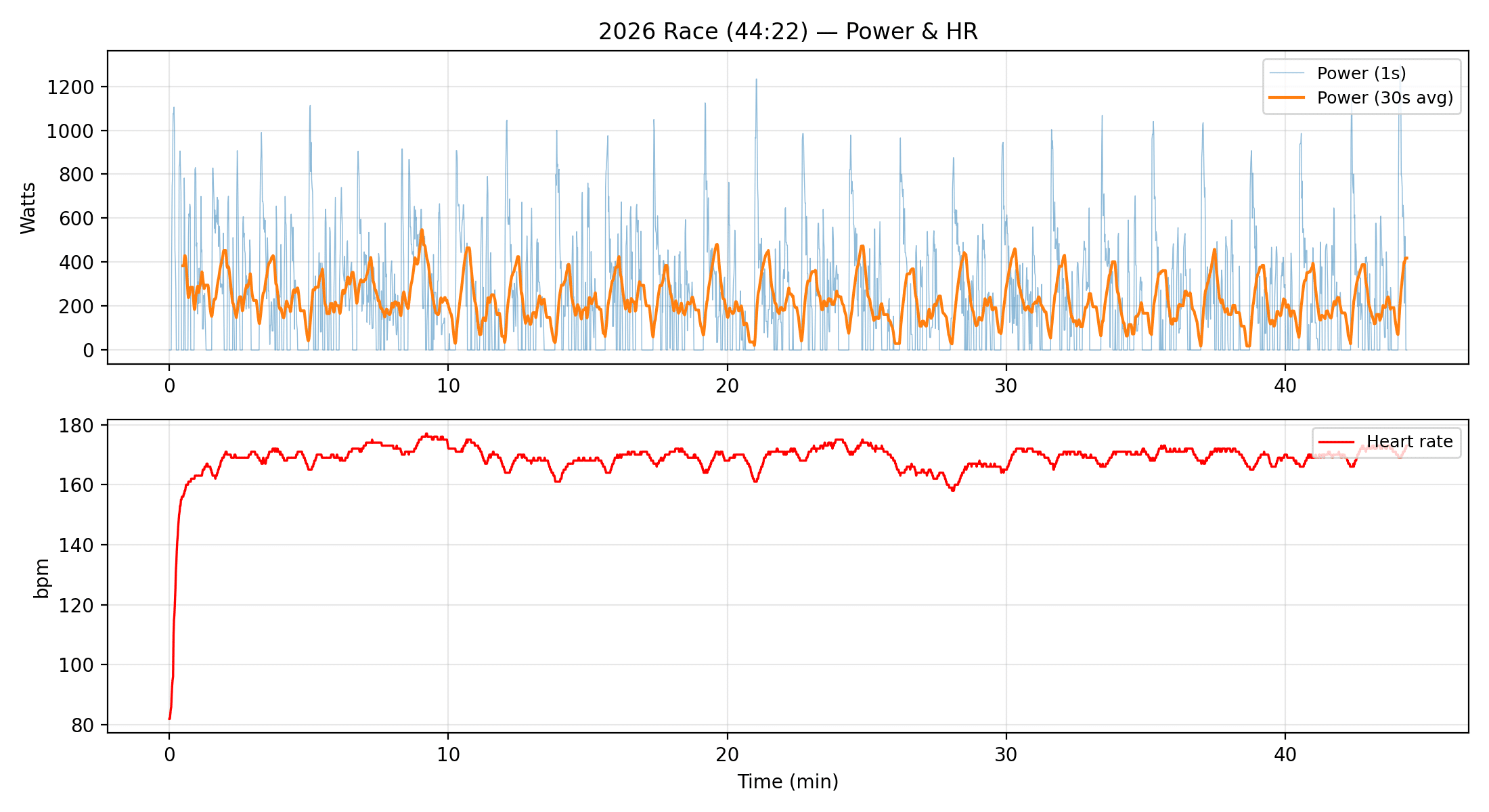
Below are the power/ heart rate traces for both races. Notice how 2026 spends more time oscillating between very hard efforts and very low power. That pattern is consistent with ‘yo-yo racing’ — repeated accelerations followed by forced recovery — rather than smooth, draft-efficient speed.
Below you'll see power and heart rate over time. 2026 is longer and more stochastic; it also shows a larger late-race fade.

Why time-in-zone can mislead (and how to use it correctly)
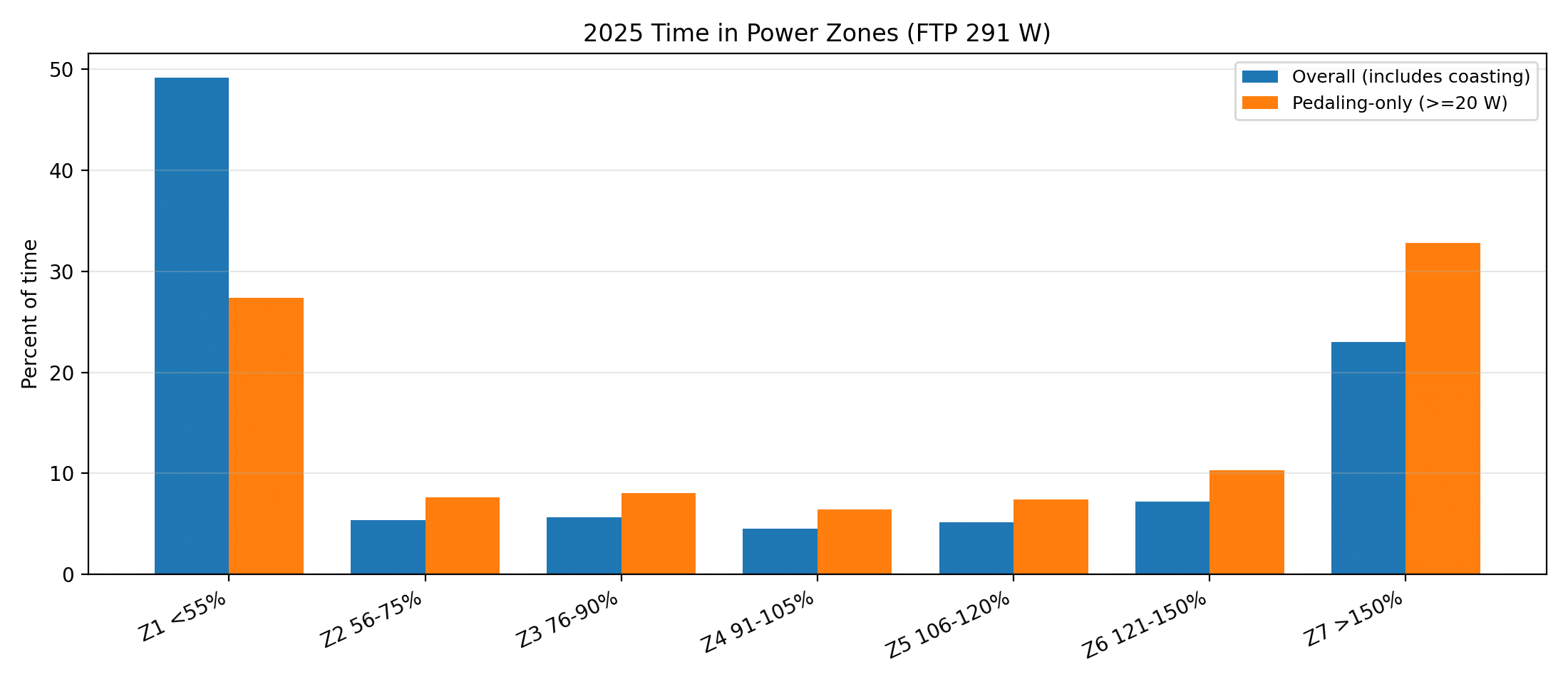
Time-in-zone is useful — but only if you separate pedaling time from total time. When a race has lots of coasting or forced recovery, the overall zone distribution can look deceptively ‘easy,’ even though the pedaling segments are extremely hard.
Below: time in power zones shown two ways: overall (includes coasting) and pedaling-only (>=20 W). The pedaling-only view reveals how demanding the race is when the rider is actually producing power.

The key difference: race economy
From a coaching standpoint, the target isn’t just raising peak power — it’s improving race economy: doing the same race speed with fewer matches burned. In 2026, the athlete spends more time at very high intensity when pedaling, yet also has more total coasting time — a hallmark of yo-yo dynamics.
Below you'll see the distribution of pedaling intensity relative to FTP. 2026 shows more high-end pedaling while also having more total coasting time — a classic sign that the rider is repeatedly forced to respond, then recover.

Coach’s checklist: what I’d change next
- Race craft: reduce panic closes (better positioning; earlier, smaller accelerations; fewer stand-up sprints to reattach).
- Durability: practice ‘hard finish’ sessions (endurance + the last 15' at race-like stochasticity).
- 2–5 minute power: build sustained surge capacity (VO2 / aerobic power) so selections aren’t match-debt events.
- Fueling: longer races amplify small mistakes; pre-load carbs and use a simple in-race plan even for ~45 minutes.
- Analysis habit: always pair VI + coasting % with pedaling-only zones — it explains the “why” faster than average power.
Data note: 2026 was trimmed to the first 44:22 to match the in-race selection and exclude post-finish roll-out. FTP used for relative charts: 291 W (2025) and 273 W (2026).
About the Author: Taylor Warren has raced at the elite level since 2014 and graduated with a Bachelor's Degree in Exercise Physiology from Colorado State University in 2015. Taylor continues to race at the elite level with CS Velo Racing, gaining experience and wisdom to help impart to the athletes he works with. Taylor is also a student of the game, with a passion for human performance and physiology, he is able to combine his race experience with an understanding of how the human body responds to training to deliver the best possible coaching experience. Taylor believes in a practical, holistic approach to coaching and training that values the athlete’s lifestyle and understands how to make the process approachable and enjoyable.
Learn more about Taylor and Source Endurance here.